

Sun Aquasystems is aware of the failed promises of algae research. Biofuel algae companies in particular have come and gone, leaving large holes in investors pockets’. (A good summary can be found here.)
We believe that one of the main problems here is the zero dimensional algae species chosen to culture. In physics nanotechnology terminology, a zero dimensional object is a point or dot, one dimensional is a line, two dimensional is a sheet, three dimensional is a volume. The definitions can get blurry, but practically all microalgae are zero dimensional. They are roughly spherical single cell (assume a spherical cow… ) with diameter on the order of 1-100 um.
This makes them really hard to culture. The first problem is that they are generally grown floating in raceway ponds or more expensive photobioreactors. This means energy must be added in the form of turbulence to keep them suspended, usually with a paddle wheel. Since each cell is floating along with the currents, the cell must rely on diffusion to bring nutrients towards its cell membrane. This process is relatively slow and the only way to increase the rate of nutrient absorption is to increase the concentration of nutrients in the bulk water. This leads to all kinds of ideas whereby CO2 from power plants is pumped into the ponds to avoid carbon limitation, or concentrated waste water is used with high nitrogen levels.
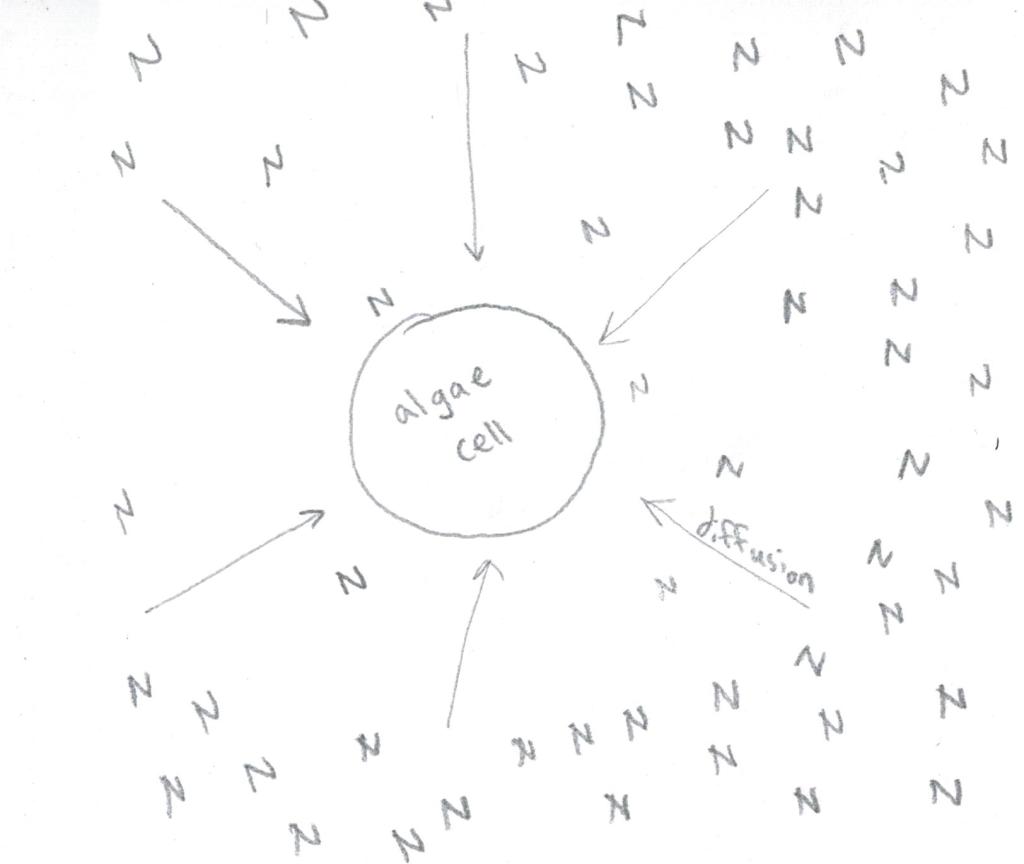
Zero dimensional algae is also very difficult to harvest. To be used as a feed ingredient it must be dewatered. Marine algae are particularly difficult because any water left in the algae will include 3.5% salt. The process typically involves centrifuges, spray drying, and H. T. Odum is rolling in his grave [3]. The clever solution would be to feed this algae directly to animals that are adapted to filter feed (ex. Oysters) and this is indeed done in some greenwater systems.
One and two dimensional algae are much better choices. These algae species grow in one dimensional strings of single cells (ex. filamentous diatoms) or in sheets one or two cells thick (Ulva Lactuca). In general they can float as plankton but most also have the ability to attach themselves to a hard substrate. In this way they are held still and water currents move past them with a fresh flow of nutrients. A boundary layer develops through which the nutrients must still diffuse but nutrient transport is much faster then the zero dimensional case. In addition, there are now two ways to increase nutrient transfer: increasing nutrient concentration and increasing water current velocity.

References
[1] Walter H Adey, H Dail Laughinghouse IV, John B Miller, Lee-Ann C Hayek, Jesse G Thompson, Steven Bertman, Kristin Hampel, and Shanmugam Puvanendran. Algal turf scrubber (ats) floways on the great wicomico river, chesapeake bay: productivity, algal community structure, substrate and chemistry. Journal of phycology, 49(3):489–501, 2013.
[2] Joseph Ekong, David M Blersch, Kamran Kardel, and Andres L Carrano. Influence of three-dimensional features of a woven-fabric substrate on benthic algal biomass production. Algal Research, 44:101661, 2019.
[3] H T Odum. Energetics of world food production. In The World Food Problems, Vol. 3. Report of the Presidents Science Advisory Committee Panel on World Food Supply, pages 54–94. The White House, Washington, DC, 1967.
 Sun Aquasystems