

This week was spent primarily on trying to design the insulation for the glazing during the night.
The guiding principles here is cost. Insulation, especially exotic forms, can be very expensive. The greenhouse insulation needs to be very thick, and cover a large area, so cost is the primary criteria. This limits the options to: Cellulose loose fill, recycled EPS styrofoam, and aluminized plastic radiant barriers. I’ll present here the steps I took in chronological order.
1) eversion is the process of growing by unfolding from inside itself. This is easy to do with small amount of pressure. I can fill a tube that grows down a test channel similar to what we’d have in greenhouse glazing. I built a test rig and it worked just fine. See video below for nice footage of a thin tube eversing, much better than what I could film. Mine did have a string down the center so I could wind it back up (deversion?) when the sun comes up.
2) fill eversion channel with cellulose for insulation? This is hard. The cellulose does not flow at all, binds up on itself. Also filling is tricky if the tube is long. Cannot everse when full of cellulose, because it does not flow.

3) Fill eversion tube with EPS beads. Bead fill greenhouse windows have been done before, this eversion step would eliminate problems with the glazing becoming clouded with dust and static clinging beads. But to test further I need to make a grinder for EPS. EPS is commonly landfilled so it should be free, but you have to source it and grind it yourself. It doesn’t make any sense to ship it any great distance since it’s so fluffy.
There will also need to be a very large storage container for the EPS when insulation is not deployed, and could be a disaster if it rips open, beads everywhere.
4) The eversion tube could have little fingers on it pointing in. These could fluff up the cellulose or EPS as it retracted to avoid the compression problems. I have my doubts as to this actually working, but when retracting the inside centre is moving twice as fast as the tip, so this speed differential might help. I have yet to try this.
5) The eversion tube could be square with pockets of insulation built into the sidewalls. Then it could be retracted and expanded pulling the insulation along with it. Insulation would probably need to be incompressibleish, so EPS / cellulose mix or similar. Cellulose packs down an is not elastic, EPS beads are pretty well incompressible at low pressure and elastic. Where to store it when sun is out may be a problem, it won’t be as easy to turn as other eversion tubes but probably could still wrap around to north side of structure or storage tubes on the ground. It’s possible that it could be entirely air powered by pressure differences in the glazing and storage area.
6) A long polyethylene sock of insulation might be able to just slide into place without eversion. The sliding doesn’t seem to damage polyethylene’s optical qualities. Greasing it with glycerin/water mixture (n= 1.33 to n=1.47) may add a bit of anti reflection coating on the glazing which would help light transmission in general. The problem is storage when glazing is open, greenhouse has to be twice as long east-west since these socks will not be able to go around corners. This is probably the simplest idea likely what I will do on the test greenhouse just to demonstrate the insulation idea works.
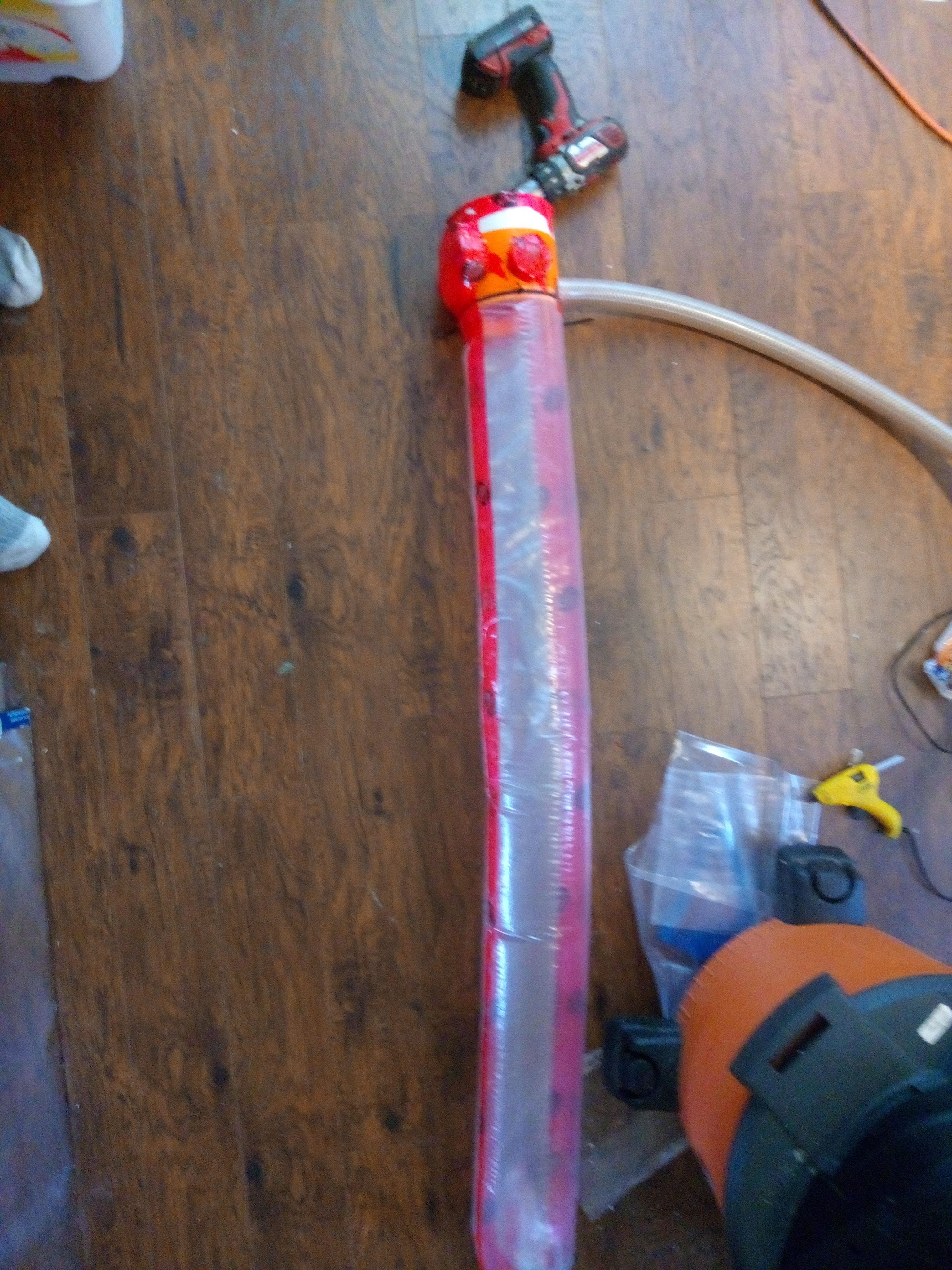
7) The eversion tube could be made of reflective plastic, with many interior layers. Then it acts like a GFP (gas filled panel) that deploys through air pressure, retracts with rope. The problem here is manufacturing even a test tube is very difficult, and it’s unknown how many cycles the aluminized plastic film would last before all the coating breaks off. The great advantage here is that at scale it could be quite cheap and there is no insulation storage problem. I tested one with 2 inner layers, aka a divider down the middle and it seems ok. Retracting it wants to buckle probably because the pull force is off centre, but in a contained channel that’s still ok. On a larger number of layers in an eversion tube, the pull channel should be the central one.

8) Other ideas are just a big blanket filled with EPS and cellulose that you can pull over the greenhouse at night. This gets into complications with high winds and snow, but this is generally how it’s done in northern Chinese passive solar greenhouses. The blanket then has to roll up, or at least reasonably flexible. In some cases it’s segmented so each part can be rolled by hand. This is sort of a back up plan. I think this would cause lots of problems in the wind (100kph wind here is relatively common) so I’m looking at a way to keep the insulation inside the double layer for now.
 Sun Aquasystems