
This was a short week due to the Easter holiday, so I’m just getting to the update now. I deployed two boxes for ray tracing with sensors in the field by the test greenhouse. Then I used rayctracer to simulate the flux on the sensor using solcast data. The bare sensor agreed well with solcast global horizontal flux, so this is another validation of the rayctracer. I still need to collect the sensor data to compare.
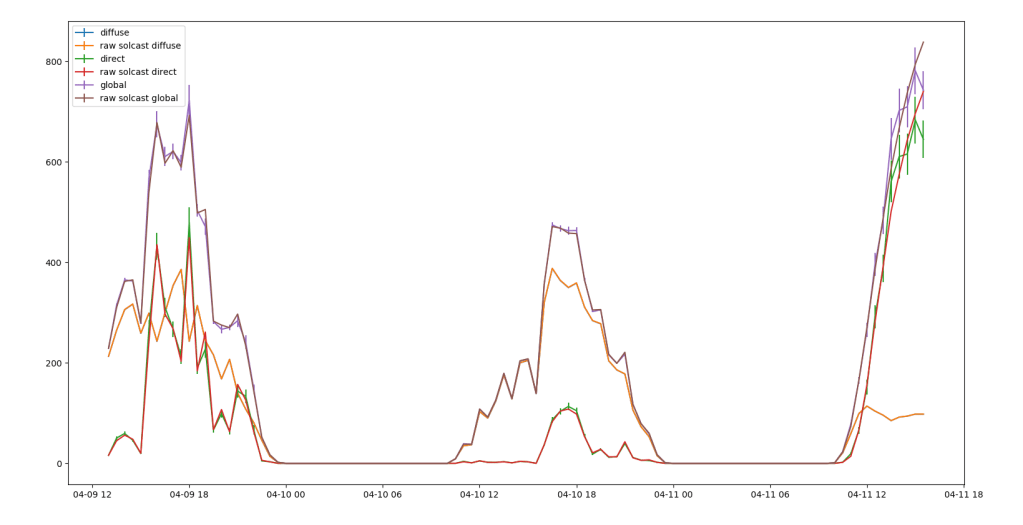
There were larger error bars on the times with high direct flux. This makes sense, because the diffuse calculation uses all the rays equally, while the direct calculation is heavily influenced by a single direction. Plus, the direct light direction is approximate in the lookup of ray tracing data. So I think the way forward is to do a good diffuse calculation and save that as simply diffuse, then do a specific ray tracing for each direct light direction. The sun’s position is easy to predict so these can be done in advance for a real time prediction eventually.
More importantly, but less exciting, I worked on tidying up the python scripts for plotting and data analysis. I like c++. Python and I have a love hate relationship. Python has tons of useful libraries that are easy to import but it’s so slow if you have to write your own loop etc. Anyhow I’m trying to organize and speed up the plotting which has been a bottle neck for me.
I also got the book “How to Grow in a Modulair Glasshouse” by Dol. It’s been an interesting read and definitely useful on the growing side of things. I will hopefully do a better job irrigating the plants and steering them in the next growing experiment. It’s interesting that commercial growers are not using a mathematical model to predict the effects of their actions on crop growth. The model of Vanthoor is probably not sophisticated enough, though Dol alludes to “AI” driven management. Something to think about in the future.
 Sun Aquasystems