

Well, I got sick. Probably just a bad cold since covid tests were negative but in this era that means staying at home. On the plus side I did get quite a bit of programming work done. I did get some nice plots of solar data comparing my sensors to the solcast-rayctracer combination:
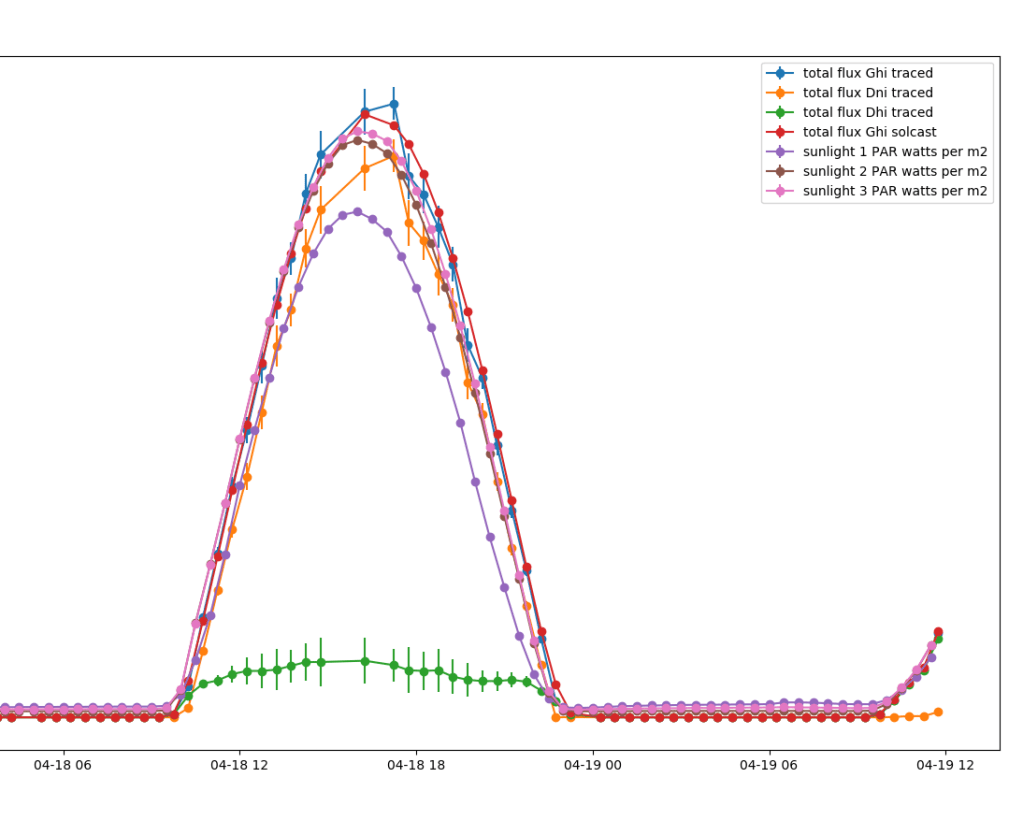
Here the Ghi from solcast, sunlight 3 and sunlight 2 and Ghi traced should be the same. It works pretty well in the morning, but in the afternoon the measurements are consistently lower than solcast and the simulation. This maybe from the sensors not being perfectly flat or pointing due south. I’ve adjusted the sensor rig to correct that, but haven’t been able to get back out to collect that data.

Here’s the same thing but with the simulation including a single n=1.55 glazing, which should match sunlight 1. Again, it’s not bad in the morning, worse in the afternoon. It’s also possible that the times are a bit off, say 15 min from improper binning.
I went back and got the modelica model of the greenhouse running with yield model integrated with everything except the sun absorption and thermal radiation. These are the parts that require raytracing. The height to the canopy is a new variable compared to vanthoor but logically it should be related to the mass of the plant stem. I oven dried a piece of tomato stem to get an estimate of dry mass per m. I also figured out how to call an external c function from modelica. Sadly no c++, but c should work.
Here is the plan:
Load all the weather data into a python script, use rayctracer to precompute all the sun absorption for various levels of canopy height and LAI for each time period. Save this data into a .csv file. Write a c program that reads that data and interpolates sun absorption based on the sun angle, LAI, canopy height that modelica inputs. This way modelica can make as many function calls as it likes without worrying about the computational effort of ray tracing. My gut feeling is that all these functions are quite smooth in the 4D space of sun azimuth, sun zenith, LAI, canopy height so interpolation should be easy.
I’d be remiss if I didn’t mention another side project which may be the results of fever dreams. Direct air capture of CO2 probably needs to happen in a big way to save the climate at this point. Previously I’d been interested in using biomass to biochar as a nice low tech solution. The problem is, the potential is kind of too small. Even using all available forests it might not be enough sequestration.
Climeworks and others are working on a chemical absorption process… It’s pricey and requires a lot of industrial capital. High hopes labs piqued my interest with the idea of crystallizing solid CO2 from the stratosphere. I crunched some numbers, it could work, but logistically all these balloon ascents and descents are a nightmare. But what about the ocean? At 380 m of depth and 4c the CO2 in air will liquefy and can be drained off. By weight 1/2800th of air is CO2, so now the problem is how to move massive amounts air to 380 m deep and back again. I have some ideas and nothing seems like a show stopper… but this is not my area of expertise. I can’t find anything in the literature detailing a similar plan, so if you know of one please let me know. Anyhow, for now this is firmly in the “side projects” bin.
 Sun Aquasystems