
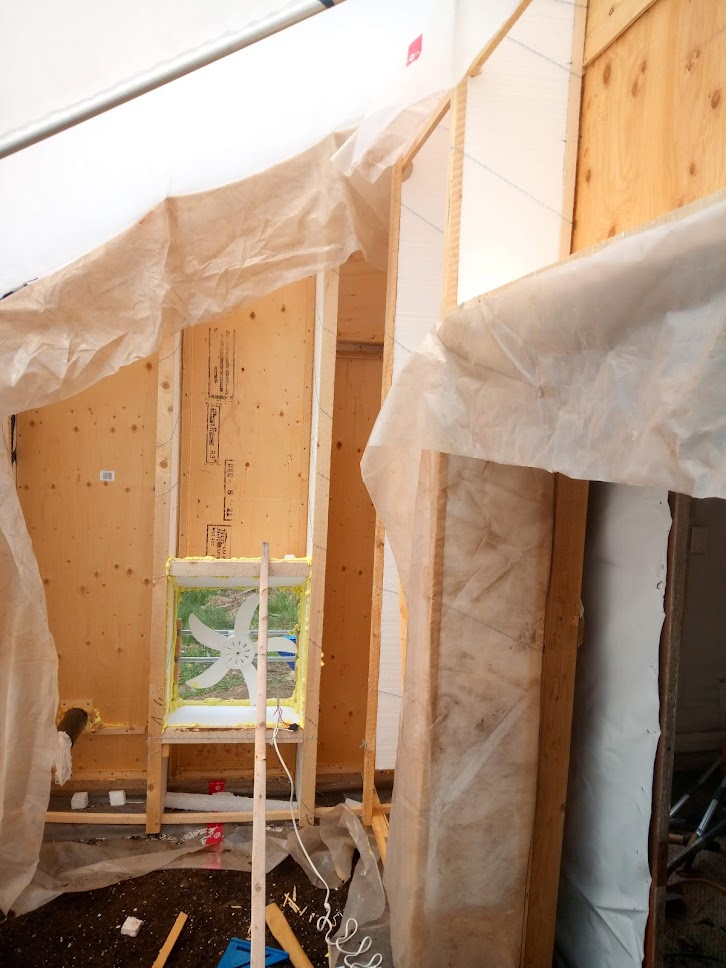
This week I insulated the north, east, south walls of the greenhouse with 12” thick cellulose. That in the end seemed to work pretty well, but the blower I had would get clogged if I tried to do dense packed cellulose. So I’ll have to measure the true R value with heat flux sensor but I think it should be sufficient.

I also got the rayctracer linked up with modelica. The simulation flow works like this:
1) select some solcast historical weather data, put in a .csv file with sun angles
2) Make a CAD model of the greenhouse, label each part with my naming convention for the optical properties. Download all of part .stl files to a folder
3) run a python script that uses rayctracer to trace all the .stl files in the folder for the given solcast data period and saves the solar watts absorbed for each part in an ascii table file that modelica can use.
4) Run the modelica simulation using the same weather data and absorption table. Here you have to manually write in the modelica file which part .stl corresponds to which part of the model.
5) Enjoy accurate simulation of greenhouse temperature and model of tomato growth.
This all seems to work except the modelica model has something wrong with transpiration where the tomato plants are heating up to 150 degrees C… So I need to go back and fix that.
A few more things I like to add are more raytracing data points so that modelica can see how changes in crop height and LAI (leaf area index) change the light absorption, and to use the rayctracer to calculate view factors for thermal radiation between parts. These are optional though, thermal radiation is generally a small effect, and in the winter crop height is limited by the greenhouse height and LAI is pretty constant.
The goal is to get this working next week and run a long simulation so I have a good idea of what is important to measure in the greenhouse this summer/fall/winter.
 Sun Aquasystems