First, the skid barn. It doesn’t work. Well ok, it sort of does but not good enough. The optimal pull angle is about 20 degrees, and that was hard to get with my pull bar. I’m sure I could redesign and get it working but the force required was still very high ( I jerry-rigged it with barrels changing the angle to test that) and more importantly it was ripping up the turf. I think the problem there is that the skid have theoretically a low ground pressure, but because they are rigid and the ground is not flat, they rest much more heavily on the peaks. Then when it is pulled, they tend to shear off the peaks.
I think the solution is to replace the skids with lots of pneumatic tires. These can deform and roll to avoid some of these problems. I am thinking of using 10 wheelbarrow wheels running about 5 psi. Another issue may be that the skids are just too heavy, and wheels will help. I think the barn needs only 200 kg to avoid flipping in the wind. The wheels will only work in one direction, but to crab or move perpendicular to the wheel track, I should be able to lift one end with a lever and make a 90-degree turn with it rolling on just one wheel on each side. The top without the skids is about 170 kg, and I can lift one end of that no problem, so light weight wheel skids should work. Now I just have to wait for the parts to come in.
The skirts seem to work well though.
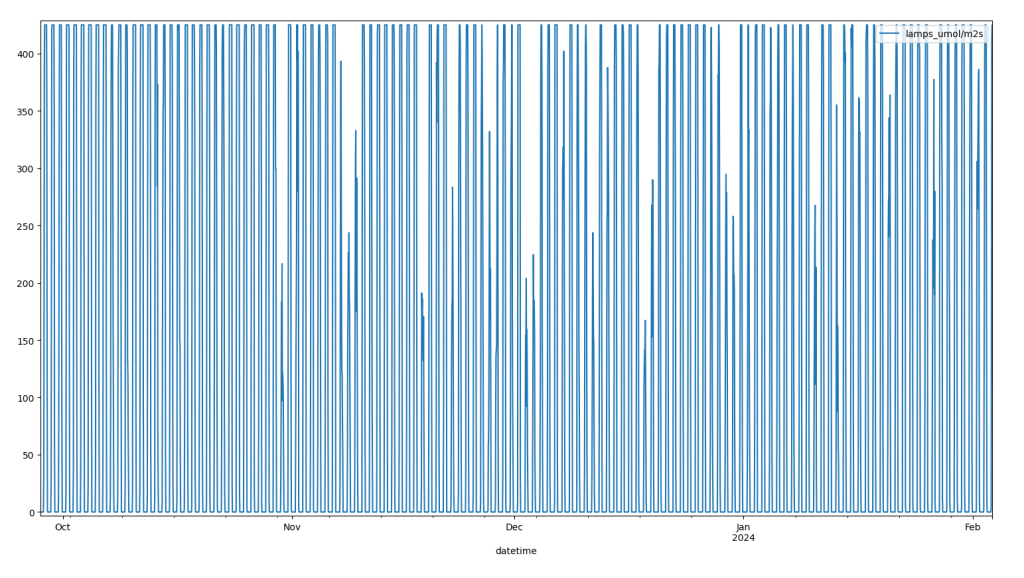
I worked on the growth chamber and it’s getting close to ready to run. I have 50, 18 watt LED tubes and with those all on, a window fan can keep it at 23c inside using 19c room temperature. I took off the plastic greenhouse film between the plants and the lights because I wanted to be able to have as high light intensity as possible. The load cells have some drift since I don’t have the retaring system here as I did in the greenhouse. I think I’m just going to live with that, the mass is not super important here and I can still get a daily integral of mass loss by doing a manual tare morning and night.
The big question is how much light to give the plants. I simulated a horizontal tomato plant in a greenhouse with my raytracer, but on some days the light absorbed by the plant would be far in excess of what the plant could use. I think this also happened to a degree in my greenhouse experiments where on sunny days they got too much sun which caused a stress response of small self shading leaves, which left them maladapted for cloudy days. So the plants need some shading on sunny days. Or in my growth chamber, I need an upper limit on light intensity. Of course, there is a physical limit of the apparatus, but what is the optimal limit for growth and yield?
Godfried Dol in “How to grow in a modulair greenhouse” states that more than 800 watts reduces the photosynthetic efficiency. I like that book but the units are unclear so I’m not sure if that’s total sun, inside or outside the greenhouse? Others used 800 umol/(m2 s) to test the maximum photosynthesis rate (Gosselin 2000), so likely the optimal light intensity is below that. Looking at Fig. 1 in that publication, and also they noted that peak photosynthesis occurred at peak light intensity for nov-april but only at 4 hours after dawn for may.

This means the maximum light intensity is likely between 800 and 500 umol/(m2s). I’m guessing on the lower end of that too, because we do not want light to encourage high light adaption on sunny days and then be left unable to efficiently use the sun that there is on cloudy days. This is for a vertical tomato plant, where the lower leaves are shaded by the upper ones. So for a horizontal tomato plant, can all the leaves be at 500 umol/m2s all day without adaption to high light? That would be wonderful, and in this case all of the leaves would be working at maximum efficiency, though a lot less of the light incident on the plant would end up being captured since the canopy is less dense. The leaf to fruit ratio could be smaller etc. I don’t think this is super likely. If I assume the top area of a vertical tomato plant as 0.7 m x 0.7 m, and the height with leaves as 2.1 m, the ratio of top area / side area is 0.33. So if we assume that the whole plant can only use the equivalent of 800 umol/m2s on the top, that is the same as 266 umol/m2s on the side of the plant to max out the plants metabolism. But the plant is less efficient at intercepting the light on the side, so the optimum value is between 266 umol/m2s and 500 umol/m2s.
So if I ray trace a horizontal tomato with the weather data from last year, and limit the amount of light absorbed to be 420 umol/m2s I get this:
If then I plot the daily light sum of the mol PAR absorbed by each plant, and the weekly running average:
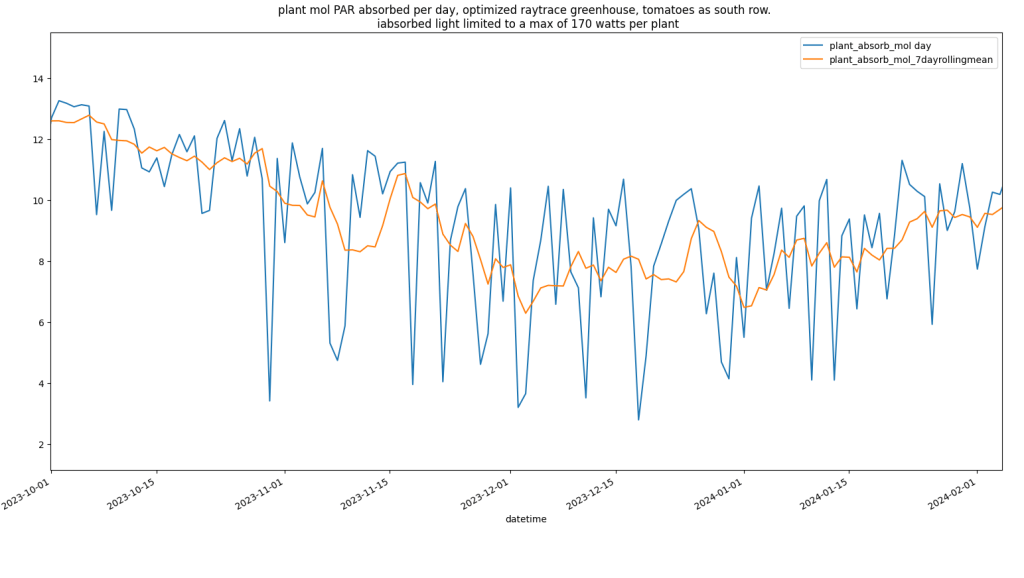
So that looks ok, but the mean light in the winter is a bit low. A tomato plant needs about 5.6 mol per day to produce a decent harvest, though max harvest needs about 8.4 mol per day. (Paponov 2022). Maybe I can get max harvest at a little bit lower light for each plant because of metabolic efficiency of laying flat… Maybe not. We will see. I will test with a 420 umol/m2s maximum intensity since that is easy doable with my setup, and because if it’s any lower than that, the daily light integral becomes so low in the winter the yield probably doesn’t make this setup worth it. As it is, there really isn’t any hope of getting full production all winter, we’re fighting for a 75% or 50% yield. So I’m not super optimistic that this will work, but I’ll try it and see what happens. At any rate, we’ll get one dataset for horizontal tomatoes which has never been tried.
Verheul, Michel J., Henk FR Maessen, Martina Paponov, Anush Panosyan, Dmitry Kechasov, Muhammad Naseer, and Ivan A. Paponov. “Artificial top-light is more efficient for tomato production than inter-light.” Scientia Horticulturae 291 (2022): 110537.
Ayari, O. & Dorais, Martine & Gosselin, André. (2000). Daily Variations of Photosynthetic Efficiency of Greenhouse Tomato Plants during Winter and Spring. Journal of the American Society for Horticultural Science. American Society for Horticultural Science. 125. 10.21273/JASHS.125.2.235.
 Sun Aquasystems