
Blog

18 apr 2024

Well, the good news is I’m still alive, the bad news is I got really sick. Just a weirdly long cold and fever. Anyhow, I’m slowly getting back to it but don’t have much information to report. 

Since wasn’t well enough to do much physical work I did look into some non-immediate projects. The land my family has heavy clay soil and often holds too much water. There is plenty of slope, about 6% grade, so the solution seems like ditches or tile drains to let the water run downhill into either ponds or the natural creek that flows through the property. 

Mapping out the slop is rather difficult, but Google Earth Pro, which is free and downloads on the computer allows you to draw a path and then see the elevation profile. I also was able to overlay a .geoTIFF file from a Canadian lidar survey (High Resolution Digital Elevation Model Mosaic – Terrain) for better elevation values but the problem with lidar is that it can be confused by tall trees, so it only works for the cleared areas of the land. And the data is old, so land that I have cleared it doesn’t know about. I suspect the USA Landsat data is better. 

Digging ditches is the easiest, and there are some ditches there from long long ago (50+ years?) but they are mostly filled in with sediment, to the point of being ineffective. So tile drains would be better and longer lasting but there isn’t anyone around here who does tile drain installs. For DIY the cheapest pipe I could find was 1 CAD per ft. At 30 ft spacing, that’s 1450 ft of pipe per acre, so the cost climbs pretty quickly if you want to do a big field. Trenching and backfill aren’t free either. 

Long ago the tile pipes were fired clay sections about 1 ft long butted up dry end to end. The water flowed in through the but joints and then down the pipe. I guess they still make them, though it’s uncommon, I found a company in New Zealand claiming that they are more durable because you can pressure wash snake-clean them without damage. Anyhow that reminded me of another thing I saw about making pavers with post-consumer plastic and sand or rock dust. This is pretty easy, just heat plastic til it melts then add the sand, and pour it into molds. There is no reason you couldn’t use the process to make tile sections. Strength is similar to concrete and underground uv and freeze-thaw cycles aren’t an issue. It would be a good use for postconsumer ABS and polystyrene (PS) which are difficult to recycle, in Nova Scotia I think they collect solid PS but the foam is landfilled. I imagine the ABS is landfilled eventually too. Anyhow, I’m not going to do that now, but if someone else wants to make me 10s of thousands of plastic/sand drain tiles I’ll take them! The pavers could also be useful for barn floors if they are significantly cheaper than pouring concrete. 
10 apr 2024

I was sick, so this may make less sense even than usual. 
6am 310 ml 
I tasted the milk, it was a bit better, and very rich, but still had a pretty intense “goat” fruity flavor. On the whole, better than last time though. 
I put black baby goat with mother at 9am. Will take away in evening (6-7pm) and milk mother in the morning at 6am as usual. My hope is only to stimulate milk production enough to take the milk once the colostrum taste is gone / if that ever happens. The bad taste may be colostrum but it may also be from grazing whatever in the field or parasites. If milk taste is bad after 2 weeks, I will probably try a hay/grain only diet for a while.

I did some work on the goat shelter skids. The bevel angle is 60 deg which is really hard to do with my tools. If I was to make one only for chickens I would do 45 degree bevel. My kids said the milk goat has diarrhea. This could be parasites, which might explain some of the low milk supply. How did this happen? Well not moving them every day could be the problem, but I have held them at extremely low stocking density, and have let pastures rest a full year before reusing.

Davidson 1981 says that it is likely white tail deer carry parasites that are spread to goats:  Haemonchus Contortis. This doesn’t actually cause diarrhea but, if its true for one parisite it’s possible its true for others, deer and goats are very similar. This is a big problem because deer are often in the fields here in NS. So even if the pasture is rested for a season, parasites may still be present if deer have gotten into the field. The parasites can survive up to 4 months. So you have only 2 options:

  1. exclude deer and keep a very long pasture rotation, close to one pass per growing season
  2. confine goats, and feed only hay or silage cut from the pastures that has been stored 4+ months. Well, probably ensiling kills faster but that still takes some time to cure.

In either case you have to keep fecal matter away from the goats feed. On pasture, you could train them to poop in a grated area. In confinement you could have the whole area on a slats (except for when kidding) or on a concrete floor that is mucked out  weekly so the parasites’ do not have a chance to get to infectious stage before they are gone. They might only develop on grass, but at any rate they don’t go faster than 7 days from larvae in a fecal pellet to larvae that can crawly out on to hay and be eaten.

Excluding deer from the field year round seems very difficult. It likely would need a 6-8ft tall electric fence. That would also have to be maintained so the brush didn’t grow to high or close on the outside. In the winter they will need to have confined pen either way because the goats would turn the field into mud, and there is no advantage to pasture, the would still need hay. In the summer, for Nova Scotia, May –  Sept on pasture they would be able to graze and need no hay. But, this also has the cost of labor to move the goat’s shelter and fencing. It seems likely that a stationary confined goat pen is better, with manure collection and spreading after treatment and then haying all the fields. This means you can’t really use the goats to clear the land, or at least not as easily.

9 apr 2024

Today I visited a commercial goat dairy and gave them an electric fence prototype. They seemed to like the idea, though they don’t often take their goats out to pasture. They also were kind enough to answer all my questions about the small dairy regulations which I appreciated greatly. I bought some milk from them which in blind testing amongst my children was indistinguishable from cow’s milk, and I mean that in the most complementary possible way.

I don’t want to say too much about this since they talked to me in confidence, but it was encouraging that they were able to meet the regulation requirements for milk testing on a small scale. Last year I built a prototype pasteuriser that did work but needs more iterations to be a viable product. The problem with that is probably the inspector won’t allow a piece of equipment that hasn’t been certified by a dairy standards organization, and that certification can be ruinously expensive. On the other hand, maybe I could get a grant for the certification if I get the prototype working properly. So I think I will still build another iteration and worry about the certification if I can get it working very well.

8 Apr 2024

Today I worked on the fences again and sorted out issues with the drive pulley. So many little things to adjust to get it to the point where I’m happy to use it. I think I’m close. I did a test and put up a square 200 ft perimeter fence in my yard, and then took it all back down in about 4 min. The fence worked well, I think I’m almost at the point where it’s as fast as just walking the distance. I’m still going to get some fences to other people for testing (if you want to test one, send me a message). The only potential trouble I can see is weight, it weighs about 14 lbs, or 6.3 kg. That’s pretty much dominated by the fence posts, it has 14 fence posts and I can’t make them much lighter without sacrificing durability. I also found that for welding polyurethane belts lower temperatures work much better. I didn’t have a way to measure temperature, but a 2-3 second blast on an old saw blade with a blow torch was perfect for melting the ends and then I was able to butt weld by pressing them together, no jig needed.

Over the weekend I continued to milk the goat and had a slight increase in milk, today was
6 am – 380ml
5 pm – 320-330 ml

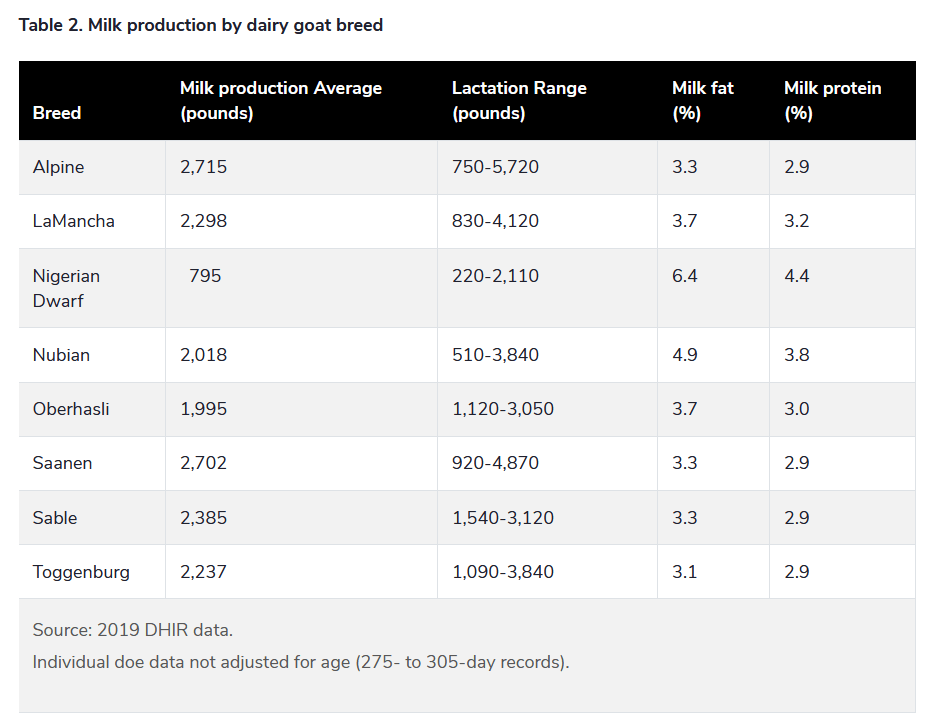
I also found this chart, which somewhat supports my hypothesis of some Nigerian dwarfs not being bred for milking. The low range is 1/10 of the high range, this more dynamic range than for any other breed of goat.

This is part of the reason why I’m interested in goat dairy though, there is a lot of room for improvement, and it’s the right size for a family farm. My ultimate goal is to develop all the equipment needed for a family farm that feeds just 10 other families. I envision something like a CSA where customers buy yearly memberships and then get year-round fruits and vegetables, but also dairy, meat, eggs, and maybe nuts or grains. By buying directly from the farm you get a fresh local product without the overhead of all the distributors. But by the nature of it being small scale, you’d never have many cows for dairy. That’s a problem because it’s very difficult to manage a herd and breed for better performance if you only have a few animals. Goats are smaller though so a herd of 10-20 does is reasonable, and that allows you to keep a buck and manage that herd. It still requires knowing about how to do that, but that’s maybe something that could be in a software package where you just add in your herd performance measurements.

5 apr 2024

Today I fixed up the fast fence to allow for on-the-fly tension adjustment. I’m not sure it’s the final design but it seems close. I am worried that the whole system is a bit too heavy. But unless I find lighter posts, that’s pretty much fixed. I calculated the cost of materials- about 77-100 CAD depending on whether you buy in bulk or not. The big cost is ASA plastic filament for the 3D printed parts, the posts, and the polywire if you don’t buy in bulk. Then for time to build it up, I’m not sure because I never sit down and do it all at once. I’m guessing about 3 hours. The wood part has to be cut and drilled, the plastic parts have to be glued together, the poly belts have to be welded, and then the wire strung onto the reels. The gluing is probably the big one, and that could probably be sped up if I was making larger batches instead of just one at a time.


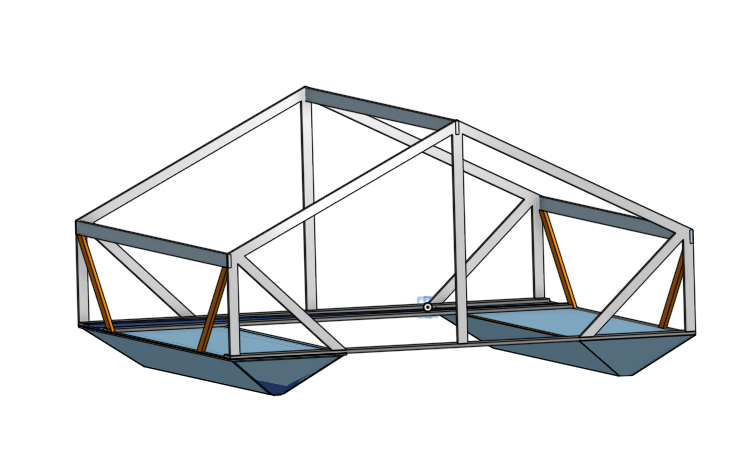
I gave my neighbor a fence to test and picked up some more lumber for better field shelter. Here’s a picture of the preliminary shelter design (12 ft long and 12 ft wide):
The idea with the floats is that it can skid over rough ground in any direction because the sloped side will ride up over any obstacle less than 1 ft high instead of increasing torque on the frame and potentially ripping the skids off. The ground pressure should be 1psi or less so no issue with soil compaction. I plan to move it with a hand winch at first daily so there is always fresh grass inside and it doesn’t get too muddy. It should work for goats, but also chickens, rabbits, pigs anything that you want to keep on pasture but needs some shelter. Should be stable without anchors in up to 100 kph winds.

milk report:
6:30 am milking – 345 ml
11:30 am milking – 142 ml
5:00 pm milking – 150 ml

4 apr 2024

On the update, today I got:
6am milking – 350 ml
11:30am milking – 145 ml
5pm milking – 160 ml

That was not quite enough for the 3 baby goats, so we had to supplement with some 100-200 ml of cow’s milk. I tasted the goat’s milk, it was horrible. It had a really strong fruity taste to it. But that is to be expected I guess, it’s still colostrum likely. It also was a snowstorm so I did not put a baby with the mother goat.

I looked up milk production rates. The best graph I could find was this, showing that milk production is at a peak 2-3 weeks postpartum. So I will continue milking until then to see what the max yield is. I still stand by my bad genetics hypothesis.

I also worked on year-end taxes and accounting today which was boring as usual.

The fast electric fence I also tested, worked ok after I modified the bottom dock to have larger holes – 10 mm holes for 8 mm posts make it easier to slide in. Someday I’ll have a video of this fence which will explain better how to use it. I had a tangle but I think it just needs a few more wire guides. I also made a new design for the handle so that it’s easy to adjust the belt tension with a turn screw. This I don’t think is strictly necessary, I like to leave the tension always high, but it’s a matter of preference and good to give the user an option.

3 apr 2024

This day was mostly dairy adventures. The goats were afraid of my flashlight but followed ok once I turned it off for the 6 am milking. The milking machine didn’t work at all, even though I had plenty of suction. I hypothesized that either it didn’t press on the teat enough because it was too big, or the goat was too scared or stressed to let down the milk. Milking by hand gave 250 ml plus all the spills, likely 300 ml total. She doesn’t seem to want to let down her milk even hand milking I would get a teat dry, wait a minute, and then there would be more there to milk again.

I milked again at 11-12 am and brought a goat kid to nurse her to see if he could get more milk than me. The mother accepted the baby right away, I
got 110 ml by hand milking. I left the baby to nurse afterward for 1 hour, then came back to see how the udder was. The udder was the same, so I think it was truly empty after that 110 ml I got by hand. The udder on this goat is small, I had alpine goats last year and there I could easily feel if the udder was full or not and got 1 litre and up on each milking.

What going on then? I think this goat is just a poor milking producer. I didn’t buy here when she was in milk so it was a shot in the dark. Just hard to believe that it was this bad. Other than perhaps some parasite problem (the goat looks fine otherwise) I can’t think of an alternative. This is too bad since I was planning on using this goat to test the milking machine. One other issue is that in my area most goats are not milked but kept as pets, so hard to find good dairy stock. I will likely have to buy another goat that is already in milk so I know that I am getting a real dairy animal, not a pet.

In other news, I did get another prototype of the fast fence built for testing and got some lumber for a portable livestock shelter. More about that later, but one of the problems with rotational intensive grazing is that if the animals need shelter, the shelter has to move with them. This can get very cumbersome, and I wasn’t able to find a good solution for sale. Another project for me. The high winds here make it a perfect test case, it needs to be stable in 100 kph wind, but also easy enough to move that you can do it daily, ideally without any heavy machinery.

2 Apr 2024

Baby goats were born in the morning, part of building a milking robot is having goats to test it on, and since the robot isn’t ready yet, I also have to do the milking by hand or with the commercially available machine. This in general is good though because you see the pain points quickly and can build the tools that save the most time First. We had 4 babies, 1 dead, 2 male, 1 female. Was a problem because the goat house slat floor ( about 1-inch gaps) trapped the babies and they could not stand. Plus the mother could not lick the legs so they were very cold. Took inside after finding them and immediately milked speedy (mother goat) with a stock mini milking machine. Got about 200-500ml, didn’t measure it as wanted to get it as fast as possible to the babies. Fed this to babies in a bottle. Was difficult to get the female baby to suck. Eventually, putting the goat’s head to my chest and tilting the head up I was able to get the bottle teat into the mouth. Once in this position, all the goats suckled vigorously.

I got only about 180ml of milk at 5 pm milking. The milking machine may not have been fully emptying the teats, I’m not sure if this is from just the goat not making a lot, or the milking machine not providing enough stimulation since the teat size is small on Nigerian dwarfs? I will try milking tomorrow with machine first, then hand milking into a bowl to see if that works better. If the milking claws ( the part that attaches to the teat) are the problem I probably can make some smaller ones with the FDA silicone and 3d printed molds.

Tomorrow I will milk at 6 am, 12 pm, and 5 pm to try to stimulate more milk production.

Daily Posts and Open Science

Hello and happy Easter to all,

This is also the start of a new fiscal year for sun aqua systems and I’m thinking that I will try a different method of communicating and documenting our research. The current greenhouse project was partly successful this winter, we did get tomatoes all through January and February, but the yield wasn’t high enough for commercial viability, and the modeling didn’t match the experiment well. So I think there is still hope for a good winter natural light greenhouse but it’s going to take a while. In the meantime, we’ve also branched out into making some fast-to-deploy portable electric fences and building a dairy robot. I’m hoping to produce the electric fences for sale soon, but I think the general takeaway here is that things always take far longer than expected, especially with our limited resources.

To keep myself motivated I’m going to try posting daily what I’ve been working on, and include the data in a sort of open science format. This is going to look ugly, I will warn you in advance. Probably the main reason open science never caught on is that it is an extreme exercise in humility. All of your mistakes are on the public record and there is no real time to smooth out the explanations and prettify the graphs etc as you work. The patent clock to file is also starting earlier if you care about that. On the other hand, I think it’s the best way to be motivated to do the best possible job, and also since I don’t often have the funds to submit journal articles, it’s a good way to keep all the work we’ve done available to the world at large. Who knows, something might happen and the company might fail before we’ve perfected a winter greenhouse, but I do want the record to be out there to help any future researchers.


The plan is to write a short post, based on my lab book notes each day, with no more than 15 min of editing time. Then if there are any requests for additional information, original data messy as that might be, I’ll also go back and post them here.

State of the Greenhouse Address

With my resolution for weekly updates over, I’ve really let this slide but here’s the status report. I did get tomatoes throughout the winter, but very few in January. More importantly, the modelica simulation of tomato yield diverged from the greenhouse actual experimental yield in about mid Dec. There are two likely possibilities.

First, the weekly light absorbed by the plants may have fallen to such a low level that the model could not accurately predict the yield. The model was not designed for environments were the plants are barely surviving. Second, I found this spring that the co2 sensor was consistently reading 300-400 ppm too high. That means the plants could have been starved for co2 once cold weather hit and the vents were almost always closed. I think the low light scenario is more likely.

The greenhouse has been revamped with new plant trays and highly reflective wall coverings. From the data we did get last winter we can see how much light is absorbed by one row of plants and this new arrangement with a lower plant density and taller plants should put the plants into a parameter regime where the modelica simulation can accurately predict their yield even during the darkest part of the year. I also got a new co2 sensor which will be tested / calibrated outside the greenhouse weekly, and the control system is setup for adding co2 if the level gets too low.

So now all that’s left to do is plant tomatoes of July 1st and run the experiment again through the winter. In the meantime, I’ve got some other smaller projects that I’ll hopefully relate on this blog as well.