It may be the shortest day of the year, but it’s still a great day for tomatoes! Plants seem to be doing ok, and it’s only going to get easier from here on out with increasing sun. We’ve had a spell of cloudy days but today is clear and the plants are benefiting. I’m reasonably confident we’ll get tomatoes through the rest of the winter.
Still providing heat for this year, but no grow lights.
Greenhouse is still working. But I had the microcontroller that controls the climate somehow die. It’s an arduino and suddenly it stopped connecting via serial to the laptop. It must have been fried somehow because I couldn’t connect it again. Anyhow I got it back up and running with a new microcontroller in the middle of the night and it all looks ok. Except that that new micro-controller didn’t work properly on pin 13 for controlling the fans. Anyhow, we limped along until the replacement parts I ordered came and now it’s all working fine and none of the electronics are held together with hot glue. I also had one of the exhaust fans stop working, probably from being exposed to the weather. I’m not sure I’ll fix that right now though because the weather is colder and I rarely need a lot of cooling power.
The weather has been kind of dim, not a lot of light available, so we’ll see how that influences production. I put white high albedo plastic on the south side of the greenhouse to try to reflect more light into the greenhouse on dim days. It seems to help some. Today there is blue sky and the south wall sensor is reading 700 watts of total solar power transmitted per m2. That’s a ton, hopefully the tomatoes can use it all. If this works ok all winter we may want to breed a new cultivar of tomato that can handle extreme changes in illumination well.
I also ran the simulation of tomato yield, vs the experimental harvest. This isn’t perfect because I didn’t have the data from the very beginning of the tomato planting since I was still building the weighing platforms. So I padded it with 41 days of sept 29th. As time goes on the simulation will be less sensitive to those initial conditions and hopefully in January it will be fine. At the moment is seems ok though, cumulative yield is matching up well even if the simulation said that harvests should have started earlier. Some of that is the problem of when is a tomato ripe and ready to harvest? I try to pick at a consistent red colour but that is my subjective colour sensing. Perhaps I should get a paint chip to compare it to…
So I’ve fallen off the horse on these blog updates, but here’s a brief summary:
The tomatoes are all still alive, though I did have some for of leaf disease or something hit two of them hard. All the leaves got brown spots, but now their new leaves are ok. I think they will recover, it may have been related to poor humidity control at night before I had automatic vents.
The greenhouse is pretty much totally automated now. I built pneumatically operated doors for the intake and exhaust vents. They seems to work quite well, reasonably tight. This allows for fine temperature control and humidity control. If the humidity rises too much I can open the doors for a few minutes and then close them. I actually had to debounce that because in the morning and evening it would be constantly opening and closing the doors as the temperature crossed the venting threshold. So now I say no more than one door open or close every 3 mins. Working so far. The irrigation system is working fine, except that once my air compressor stopped (maybe triggered an overheat switch?). Anyhow it started back up but not before it irrigated a bunch extra. Not a big deal but now I have dual redundant air compressors attached to the same line so it doesn’t happen again when I’m not right there to fix it. Hurricane Fiona knocked out the power for a few hours but I was able to run everything off the generator so no issues there.
I built a blanket that rolls down over the glazing at night. Looks good so far I just need to test the actual R-value. It’s nowhere near what I eventually want ( I estimate between R-3 to R-10) but should be good enough for this winter with the heater (1500 watts). This winter the goal is only to measure light capture and determine if it’s enough for tomatoes in January. The blanket rolling system is me with a crank made from a piece of rebar which is not automatic. I have some motors but I’m not sure I will use them in this application. When there is snow I will have to be there regardless to sweep it off before roll up and down, so maybe it doesn’t save much time to automate.
This week I got the vent doors finalized for manual operation and sorted out bugs in the irrigation system. The irrigation seems to be working fine, when the slab of 3 plants transpires 500 g of water, the irrigation sends 550g more. This slowly brings the slab up to saturation which I think is what I want. Any how, it worked in the paper “Irrigation Strategies for Greenhouse Tomato Production on Rockwool “ Saha 2008. The plants look fine, lots of fruit developing and quite tall (5 ft). I also covered the inside walls with white silage tarp, which isn’t quite as reflective as aluminized mylar, but a lot more durable. The albedo is like 90% which I think it probably good enough to see if they can produce all winter.
The vent doors are simple sliding doors that seal with a neoprene foam gasket. For now they are manual, but the parts are on order for automation. Good thing they are in place because the nights have been getting colder than 15c, so the heater is kicking on. The blanket project to keep it warm without heating is on hold because the plastic I ordered got lost in the mail… still waiting on fedex to find it.
Well last Friday I planted the tomatoes into their big slabs. Then the mass measurements were all over the place. Without irrigation the mass should be monotonically decreasing, but it was making significant jumps. This was bad because I needed that mass data to run the irrigation timing algorithm. I figured out that the error was from the plant tray rubbing on the guides, piece of wood that keep the tray in the proper orientation when it’s being lifted for tare. The fundamental problem was I used one central piston for lifting, then as it came down it could twist and rub on the guides. This was sort of random so it could cause the mass reading to go up if it was fetching on something taking weight off the load cells. I tried a bunch of solutions, but the one that I put in today used 3d printed ramps on the tray and the lift plates that always try to slide the tray back into centered as it comes down. I used PETG plastic which is pretty slippery so hopefully that works. The proper solution of course is to use 2+ pistons for lifting each tray. I ordered some, but the delivery time was really long (1 month) so the temporary solution needs to work pretty well.
I got my PAR reading system working again. I was using a ADC on an arduino nano but the noise was really high for some reason. I switched it to a Phidgets VINT Hub and works great. I can’t recommend Phidgets enough. The stuff works really well with minimal fussing.
I also worked on tight doors for the ventilation openings. I made one that seals pretty tight using a neoprene gasket. The door slides up and down on bearings and then to seal I made 3D printed ramps so that pushing down on the door pushes it in towards the wall and seals. Actuation will be with a pneumatic piston since I already have the compressed air setup, but that’s a month a way too. For now I can just move it manually.
The tomatoes seem to be growing just fine despite the irregular watering this week. Some small fruits developing, plenty of flowers. I did have some leaves getting spotted, perhaps fungal issues. It has been very foggy here, which in the morning/night can lead to condensation.
Since the last update, I’ve been working on the insulation blanket. My method of spot welding 6 mil poly with a modified soldering iron turned out to be way too slow / hard to control the quality. A robot could probably make it work but I have trouble getting the timing by hand. I build a new poly welder which seems to work in tests, I just have to bring it to the hall where I’m building the blanket (I needed a big clean space with no wind so outside wasn’t going to work.) This new welder is still a spot welder, but it makes a 150 mm weld when pressed for 5 sec, so it goes much quicker. 3 amps seems to be the sweet spot for a good weld that doesn’t cut through.
In other musings, carbon capture will be necessary in the future and the simplest was to do this is burn biomass, collect the exhaust, and sequester that CO2. Or you can make biochar, which would be about half as effective (still releasing some CO2) but it’s easier to sequester biochar than gaseous CO2. Our previous work on ATS (algal turf scrubbers) could be a way to do this without taking land away from farming or wilderness preserves. The algal turf grows fast, 3-10 times faster at making biomass than a forest or cropland. It can be harvested and collected in a wet slurry pretty easily. Dewatering it is hard, but if the slurry is aerobically digested, there is no need for dewatering. The biomethane can then be collected and stored. If the power plant is integrated with an air liquification plant, liquid oxygen can be made from air when renewable power is cheap. Then when electricity is needed (calm dark days) the power plant can burn liquid oxygen and biomethane which will produce an exhaust of pure water and CO2 for sequestering. I calculated that to convert all the worlds natural gas to biomethane from ATS you’d need about an area of ocean the size of New Zealand… or maybe 2 New Zealands depending on how productive you could get your ATS. But for the moment, we’ll continue with the greenhouse project. One thing at a time.
Sorry again for the lack of timely updates. The tomatoes are doing well and have now the beginning of buds. Soon I’ll have to plant them into the big rockwool slabs. The trays that hold the slabs and weigh them have been a big problem. No matter what I’ve tried I can’t get the HX711 breakout board to operate reliably to read the load cells (scale) with arduinos. 75% of them (from different sources and with different layouts) don’t work out of the box and when I do have it working it will often just stop. So, I ordered a usb load cell reader which should allow me to read the load cells from the laptop directly. I’m not an electrical engineer by any means but it all seems like it should just work. Anyhow the usb load cell reader should come on monday so I’ll try that, and hopefully I won’t have to plant before then.
The weather has been odd. No rain but hot and humid everyday. My well pump broke, maybe due to low water levels, and the misting cooling doesn’t work when it’s this humid. I’ve kept it below 33c in the greenhouse with shading so far though. In the final version, the glazing insulation will be useful for shading too.
I did develop a technique to weld or at least spot weld 6-mil polyethylene sheets with my soldering iron. These are silage cover plastic or home construction vapor barriers. The plan is to make a blanket out of these insulated with fiberglass batts. Then it can be rolled up and down over the glazing for good insulation at night.
This week was the week all the parts arrived. The new relay board works fine. The misting pump motor still sometimes resets the micro controller when it kicks on but I’ve been able to deal with that rare occasion via software. I will not use a DC pump again, I think that’s the problem anyhow, poor shielding and grounding on a DC pump.
The new plant tray works great. The pneumatic piston is reliable and doesn’t leak saving the life of my air compressor. The load cells still seem to be working and it tares every 5 mins. I have the tomato seedlings in it now.
The weather was very hot and humid (for Nova Scotia). Temperature was 28c with 81% humidity. The misting was working, but it made the greenhouse supper wet and I was worried about fungal diseases on the tomato plants. I built a little tunnel tent structure (opaque white poly) around my greenhouse intake vent and put the misting in there. That cooled the air before being blown into the greenhouse. I also made a large shade that out of white poly that I can deploy and cover the whole glazing roof. This limits light, but at this small stage the plants don’t really need that much light so I think it will be ok.
I had to rewrite pretty well all of the controls programming. The serial between the arduino mega and the laptop is unreliable. So I put all the mission critical stuff into the arduino. I then had the logger program automatically reset on the laptop is logging stops. So far (4 days) it seems to be working.
I built my eversion based vent door, it works ok but needs higher pressure air than I anticipated.
Partially built. Stepper motor to drive it and lots of 3D printed parts. I forgot to get a picture with all the air tubes.
I might pause this because I have an idea for the glazing insulation. The shade overtop of the glazing was actually really easy to deploy. Since the glazing is inflated, you can pull the edges of the shade down and the glazing yields but pushes back keeping it taught. Even in the wind I had no trouble. Granted it hasn’t been that windy, but I think I could make an external R-20 blanket with fiberglass batts that I can deploy by hand. Lots easier than the eversion through glazing to setup. This is just to test the hypothesis that the greenhouse can run all winter with no heating, it doesn’t have to be practical at commercial scale yet. The first step I think is to make a big sheet of full poly that can cover all the glazing and work out the best method of moving that across the glazing.
This week I waited for parts. Well a bit more than that, but it felt like I was always waiting! The tomato seedlings were transplanted on to the plant topper rockwool cubes. These will eventually go in the the “slab” which is a large block of rockwool that supports 3 plants. For now, all the cubes are just in one tray, each with their own dripper. It’s hard to find good information about this stage of propagation, most experiments (and large growers) seem to order them from a transplant supplier. I just don’t have the connections for that. According to the best information I can find I’m giving them ½ concentrated fertigation and irrigating about once a day in the morning to about 80-90% saturation. The plants are small so they are not transpiring out a lot of water yet… But the drain (runoff from watering) is about the same EC (electrical conductivity, indicator of amount of nutrients in the water) as the fertigation water so I think it’s ok.
I got the next iteration of my slab weighing tray working using pneumatic cylinders. Mechanically it seems fine. Electrically, I had tons of trouble with the HX711 load cell ADC chips. I had to solder up like 6 to find 2 that worked. Plus I had tons of trouble with poor connections. I finally went and learned how to make a custom PCB (printed circuit board) to mount everything for the load cells. Those are on order (next week delivery?) and should make it much easier. I also ordered more expensive HX711 chips from a Canadian supplier so hopefully those will be more reliable.
But that’s not all! Activating the pneumatic solenoid valve with the relays I have restarts the arduino Mega micro-controller. So I ordered a new relay board that has optocouplers. This uses light inside a chip so that the controls (arduino Mega) and power being switched (solenoid) are electrically isolated. This problem also happens occasionally when the pump for misting turns on. I sure hope that does the trick, otherwise I’m not sure what to do. Faraday cage around the Mega?
The misting system worked to keep temperatures below 30c on some hot sunny days this week, but I did have trouble with the mister heads clogging up. I put in a 1 micron prefilter, but since then it’s been cool enough not to need the misting.
This week I’ve been babying my tomato seedlings and working on the rest of the greenhouse. The tomatoes have sprouted and once they get their first true leaf I’ll put them onto the tray with load cells.
This gives me a bit of time to rework the trays. The idea of using a low pressure bag to lift the trays sounded good… but I was not able to make a reliable bag. The version I have now uses a hot water bottle, which does work, but I’ve already burst one hot water bottle from over pressure. The proper solution I think is a real pneumatic cylinder and solenoid valve for switching it. I tested this version this week and it seems much better. I was going to have it ready to install today but my soldering iron broke. It’s fixable but I need a soldering iron to fix it… The end result is I have to wait until monday to get a new one and test out the load cells in my new pneumatic cylinder tray.
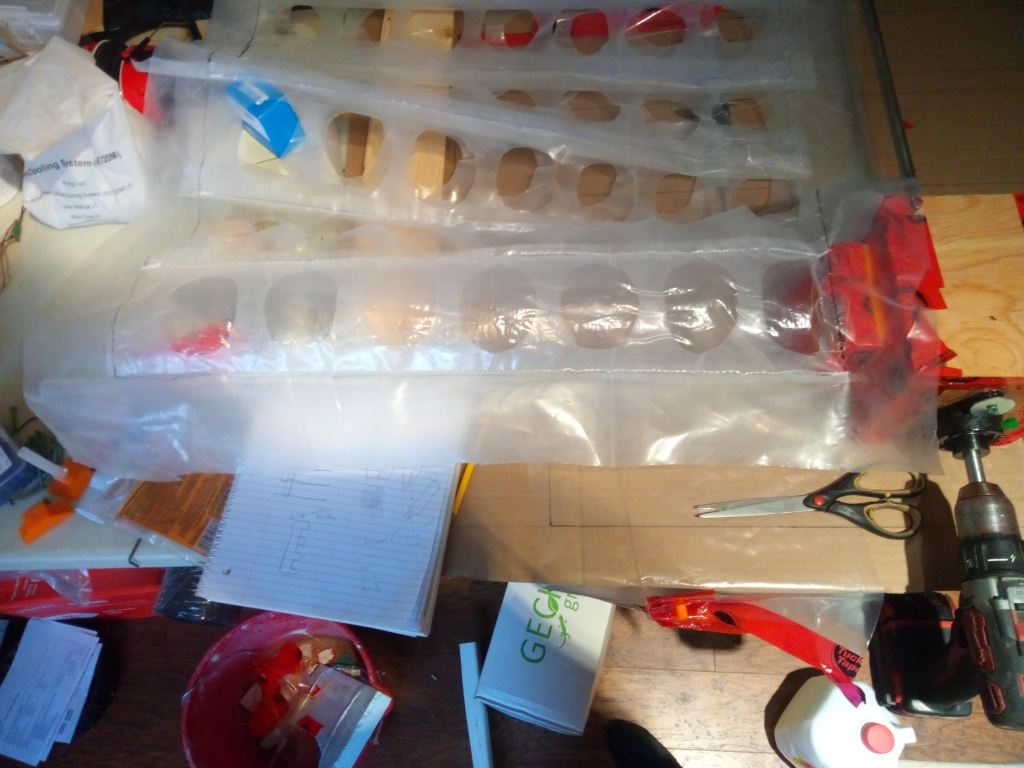
I also worked on the vents. For the time being, I’m just opening and closing the vents manually, I have some insulated panels that I stick in the holes. This is not very air tight, but it doesn’t need to be for this time of year. I made a prototype eversion rig that can deploy and retract an inflated tube through a channel. The idea is that this seals the holes in the channel via air pressure, closing the vent.
The ovals are cut in the outer layers of the channel, the tube inflates in this channel and seals the holes.
There is a ribbon or rope on a reel in the centre that allow the tube to be retracted. My current thought is that this rope could be a bundle of aluminumized mylar tubes. Once it’s been pulled into place but the air pressure of the eversion tube, it can be inflated with CO2 or argon for insulation. I tried making a prototype aluminumized mylar tube but it was very difficult to seal. I need to make something like a seam sealer so I can weld the mylar together.




 Sun Aquasystems